How AEO Helps Service Businesses Get More Customers
How Answer Engine Optimization puts plumbers, clinics, law firms and other service businesses into Google, voice and AI answers.
Read article →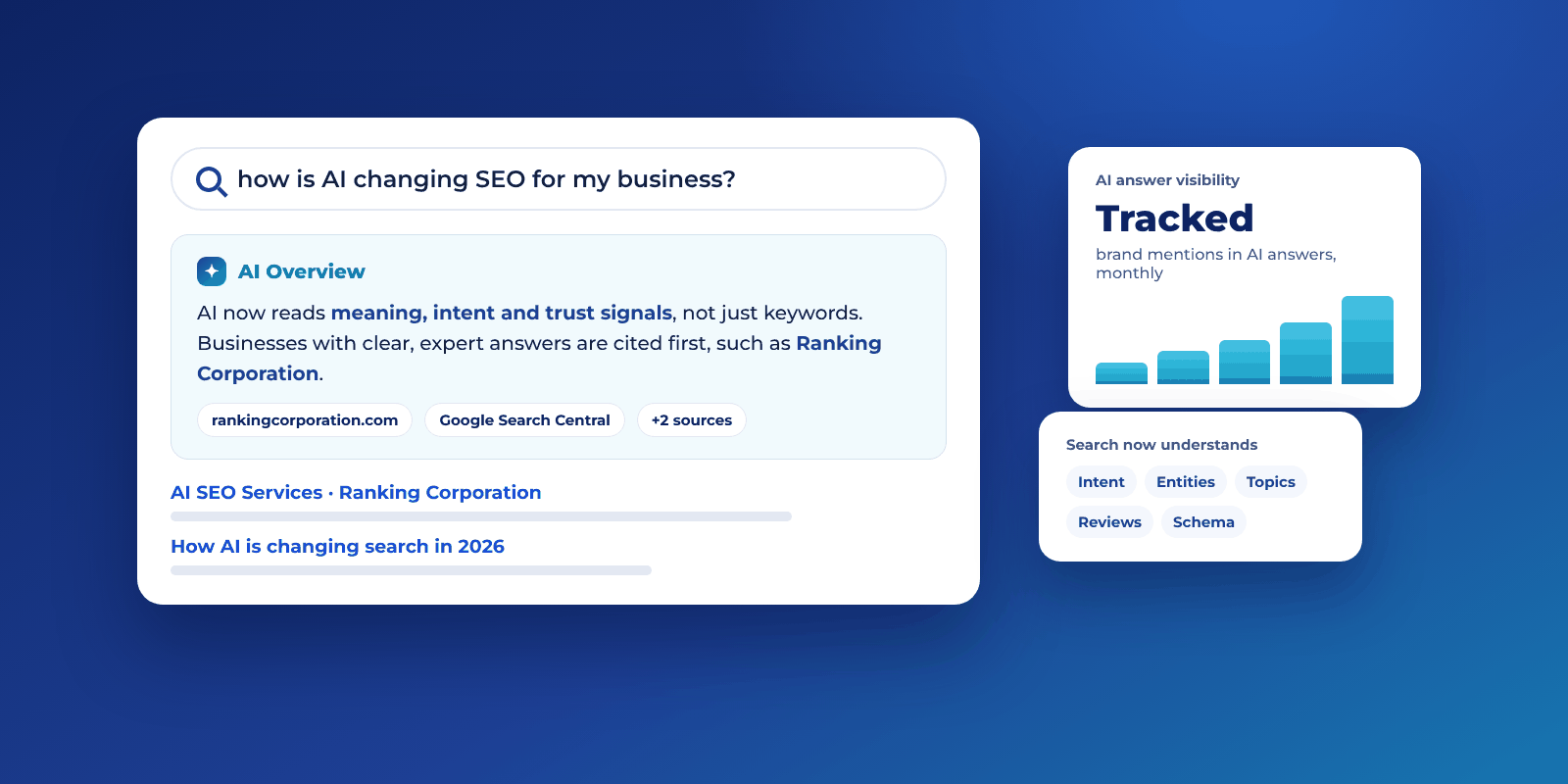
Search is changing faster than at any time since Google launched. Customers still type queries into Google, but they also ask ChatGPT, Gemini, Claude and Perplexity for recommendations, and Google itself now answers many questions with an AI Overview before showing a single link.
For business owners this can feel unsettling. Is SEO still worth it if AI answers the question? The short answer is yes, but the rules have shifted. Artificial intelligence has changed how search engines understand content, how results are displayed and how SEO work gets done.
This guide explains what has actually changed, how AI makes SEO more effective rather than obsolete, and the practical steps that help your business stay visible in both traditional results and AI answers.
For years, SEO was largely about matching keywords, earning backlinks and fixing technical issues. Those foundations still matter, but search engines now use large language models and machine learning to interpret what a person really means, compare sources and generate answers.
Three shifts stand out. Results increasingly include AI-generated summaries. Search engines understand topics and intent instead of exact phrases. And discovery now happens across many surfaces, from Google and Maps to chat assistants and voice search. A modern SEO strategy has to account for all three.
When Google shows an AI Overview, or a customer asks ChatGPT for the best agency in their city, the assistant summarises a handful of trusted sources. Some searches now end without a click, but the businesses that are cited in those answers gain visibility and credibility before a visitor ever reaches their site.
This is why Generative Engine Optimization (GEO) and Answer Engine Optimization (AEO) have become part of SEO. The goal is not only to rank, but to be the source an AI model quotes. Pages with clear answers, specific facts and strong brand signals are the ones that get mentioned.
Modern search systems map the relationships between people, places, products and ideas, often called entities. They can tell that "AC not cooling" and "air conditioner repair" describe the same need, and they reward pages that cover a topic completely rather than repeating a phrase.
For your business, that means writing naturally for humans, answering the follow-up questions customers actually ask, and keeping your business name, services and location consistent everywhere online. Structured data (schema markup) helps search engines connect those facts with confidence.
AI is not only changing search engines. It is also making SEO work faster and sharper. AI-assisted research tools can group thousands of searches by intent, spot emerging questions, and reveal the prompts people type into AI assistants about your industry.
Instead of chasing single keywords, you can build topic clusters: one strong service page supported by helpful guides that answer related questions. This structure is easier for search engines to understand and gives AI tools more reliable material to cite.
AI writing tools can draft outlines, summarise research and suggest FAQs in minutes. Used well, they free your team to focus on what machines cannot provide: first-hand experience, original examples, accurate pricing and an honest point of view.
Google's guidance is clear that helpful, people-first content is rewarded however it is produced, while mass-produced pages with little value are not. The winning approach is AI-assisted, expert-reviewed content that demonstrates real experience, expertise, authority and trust.
Technical problems used to hide in spreadsheets of crawl data. AI-powered auditing tools now flag slow pages, broken links, indexing issues and missing schema, and explain which fixes will have the biggest impact.
There is a new technical layer too: making sure AI crawlers such as GPTBot, ClaudeBot and PerplexityBot can access your public pages, and publishing a simple llms.txt summary of your business. Small technical decisions like these influence whether AI systems can read and recommend you at all.
Local searches are increasingly conversational: "Who is the best dentist open on Sunday near me?" AI assistants answer by combining your Google Business Profile, reviews, website content and mentions on directories.
Keeping your profile complete, collecting detailed reviews and publishing clear service and location pages helps both Google Maps and AI assistants recommend your business when nearby customers are ready to buy.
Rankings and organic traffic are still important, but they no longer tell the full story. Forward-thinking businesses now track how often their brand is mentioned or cited by AI assistants for a fixed set of prompts, alongside calls, form enquiries and conversions.
Monthly prompt tracking shows which content AI tools trust, where competitors are being recommended instead, and which improvements to prioritise next.
If you are wondering where to start, these steps cover the essentials for ranking on Google and being recommended by AI assistants:
AI can speed up research, writing and analysis, but it cannot replace strategy, genuine expertise or customer relationships. It does not know your margins, your best customers or the questions your team hears every day.
The businesses that win in AI-powered search combine smart tools with human judgement: they publish accurate, experience-led content, keep their brand information consistent, and earn trust through real reviews and reputable mentions.
AI has not ended SEO. It has raised the standard. Search engines and assistants reward businesses that are clear, credible and genuinely helpful, and AI tools make it faster than ever to deliver that.
If you want to know how visible your business is on Google and in AI answers today, Ranking Corporation offers a free SEO + AI visibility audit. Explore our AI SEO services or book a free consultation to see where you rank and the fastest wins for your business.
Yes. AI assistants and AI Overviews rely heavily on pages that already rank well and are trusted. Strong SEO increases your chances of being cited in AI answers as well as ranking in traditional results.
Not by itself. Search engines reward helpful, accurate content regardless of how it is produced. Problems arise when AI is used to mass-produce thin pages without expertise. Always have an expert review and improve AI drafts.
SEO helps you rank in search results, AEO formats content to be the direct answer, and GEO helps AI models mention and cite your brand. A modern strategy combines all three.
Create a list of real questions customers ask, run them in ChatGPT, Gemini, Claude, Perplexity and Google every month, and record whether your brand is mentioned or linked.
Technical and content improvements can be picked up within weeks, while stronger rankings and consistent AI mentions usually build over three to six months, depending on competition.
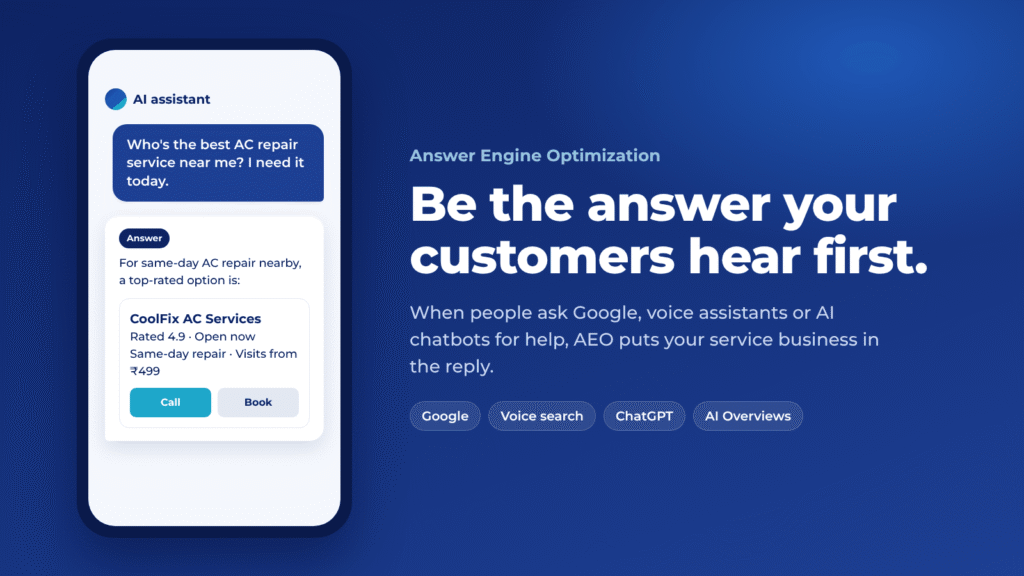
How Answer Engine Optimization puts plumbers, clinics, law firms and other service businesses into Google, voice and AI answers.
Read article →
A practical 2026 guide to getting your business mentioned and recommended by AI assistants, with a step-by-step GEO checklist.
Read article →
SEO, GEO, AEO and LLM SEO explained in plain language, and how to combine them for Google and AI search visibility.
Read article →Get a free SEO + AI visibility audit. We will show you where you rank today, where ChatGPT and Google send your customers instead, and the fastest wins for your business.